I’ve been more disorganized than I thought I’d be on my residency in Houston! That’s by way of saying, I don’t have any extensive reports, but more generally, I’ve been working two prongs: one, learning more about port operations and sidling up close to big ships and black boxes; two, jellyfish – learning about them, conceptualizing a world dominated by these “global citizens” and figuring out inventive ways to eat them.
I had the honor of spending a day with Juli Berwald, a science writer spending a lot of time thinking about jellyfish.
But this post is primarily a link to Monterey Bay Aquarium’s live jellyfish cam, featuring sea nettles (Chrysaora fuscescens).
I hadn’t quite connected big box stores to container ships, and the idea of non-space and non-place, til i came across this still.
Marc Augé writes about non-place in his eponymous book on Supermodernity , and Robert Smithson of course said it first (“non-site, the gallery as a kind of blank):
Allan Sekula and Noël Burch, still from The Forgotten Space (2010)
The Forgotten Space follows container cargo aboard ships, barges, trains and trucks, listening to workers, engineers, planners, politicians, and those marginalized by the global transport system. We visit displaced farmers and villagers in Holland and Belgium, underpaid truck drivers in Los Angeles, seafarers aboard mega-ships shuttling between Asia and Europe, and factory workers in China, whose low wages are the fragile key to the whole puzzle. And in Bilbao, we discover the most sophisticated expression of the belief that the maritime economy, and the sea itself, is somehow obsolete.
From Smithson’s writings:
Oblivion to me is a state when you’re not conscious of the time or space you are in. You’re oblivious to its limitations. Places without meaning, a kind of absent or pointless vanishing point.
Instead of putting something on the landscape, I decided it would be interesting to transfer the land indoors, to the Non-site, which is an abstract container.
As part of SSC’s inaugural tasting and brainstorm event, I made a new version of a jellyfish granita that Lucullan Foods and I developed at Rice U in March.
We decided to top the granita with a sweet sashimi – we wanted local geoduck clam, but couldn’t get any, so went with Kampachi (“boutique yellowtail) which is responsibly farmed in Hawaii. I admit this isn’t the most rigorous menu decision.
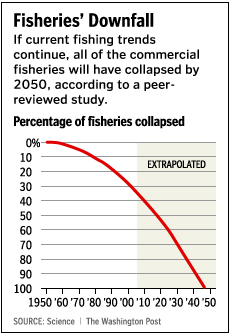
The web page of kampachifarm.com, one of the aquaculture producers has some horrifying fishery collapse statistics, like this one:
I appreciate kampachifarm.com‘s commitment to responsible production. Their web site has extensive information. But there are serious oversights and gaps in the base assumptions that we must eat fish, that demand for healthy omega-rich seafood is escalating (population increases, access to global products to name just 2) , and that in order to save the ocean’s wild fisheries, we must farm and do so in ways that do not put more pressure on the ocean ecosystem. And as we move away from wild-caught feedstock (it’s getting scarce and prices have soared) for these farmed fish, we need to feed them a high protein substitute grown on land… like… SOY. Wait… isn’t that also a problem? Sounds like monoculture support or at least, elision of how soy aggravates land-based environmental poverty.
Lastly, when I savor my tiny, tony sliver of kampachi tonight, I want think about the life this fish had in this sea-bound ball:
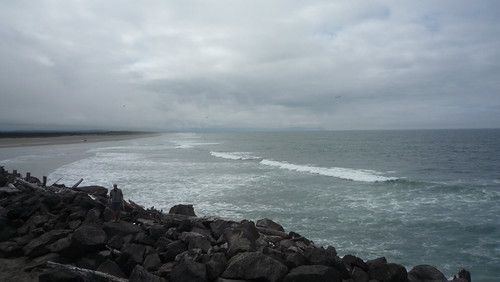
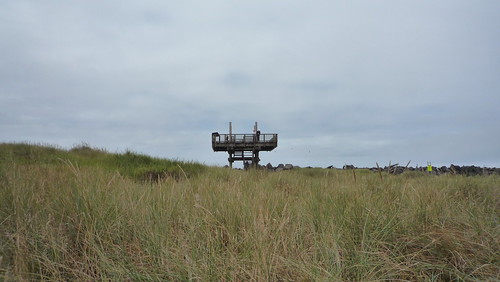
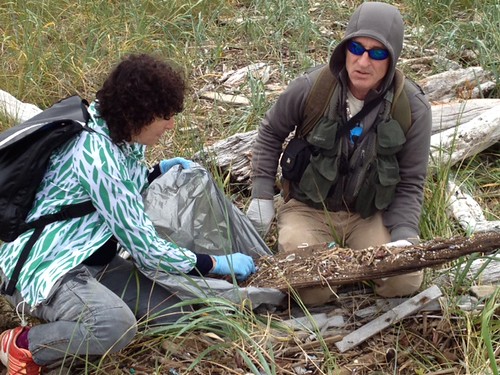
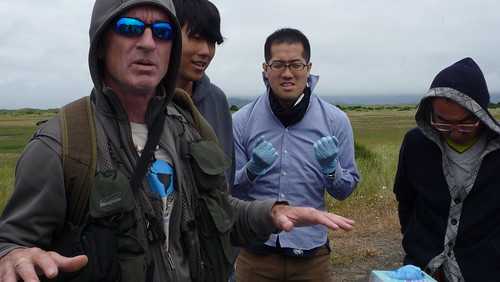
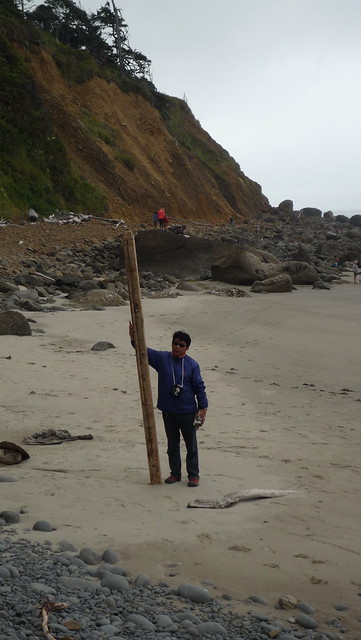
10 days ago I went to the OR coast – around Astoria, the mouth of the mighty Columbia River, with 15 Japanese continuing ed students to survey the beach plastics and look at and for tsunami debris. Oregon is twinned, connected to Japan through a strong east/west current. In addition, long-livin’ plastics suspended in the N Pacific Gyre, the trash vortex bigger than Texas and described as a 300 foot deep cloud of plastic bits, broken into ever-smaller bits by the sun’s UV, masquerading as plankton, and colorful confetti, gets dumped back out, into the currents, and lands on the coastal beaches.
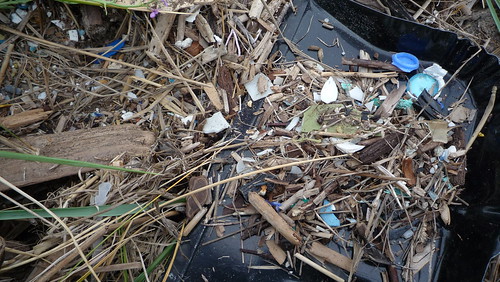
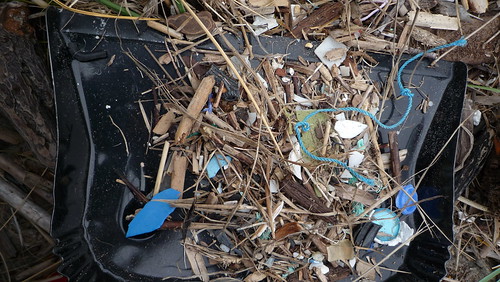
We spent an hour cleaning – if you can call it that – I sat in one place for 45 minutes, overturning sticks and small logs to find an almost-solid layer of post-consumer plastic bits, nurdles (pre-consumer plastic resin pellets), oyster farm tubes, styrofoam nuggets, to mention a few, from the vast polymer taxonomy.
Marc Ward of Sea Turtles Forever, a committed beach plastic clean up leader and educator, with some of the PNCA crew
I can’t seem to draw myself away from plastic – what’s been coined The Plastisphere.
To date, though, how the Anthropocene has created new ecosystems in the oceans as well as on land has not been much examined.
Such ecosystems are, nevertheless, emerging—as Tracy Mincer of the Woods Hole Oceanographic Institution, in Massachusetts, and Linda Amaral-Zettler of the Marine Biological Laboratory, also in Woods Hole, describe in Environmental Science and Technology. The malign effect of floating plastic debris on seabirds, turtles and other sea creatures is well known. But, as Dr Mincer and Dr Amaral-Zettler have discovered, plastic debris also provides a new habitat for organisms small enough to take advantage of it.
The two researchers collected pieces of plastic from various sites in the North Atlantic. They then examined each using DNA analysis, and also an electron microscope, to see what was living on it. Lots of things were. Altogether, they discovered about 50 species of single-celled plant, animal and bacterial life. Each bit of debris was, in effect, a tiny ecosystem.
As with many ecosystems, the bottom of the food chain was occupied by things that photosynthesise. These included unicellular algae called diatoms and dinoflagellates, and photosynthetic bacteria known as cyanobacteria. Usually, such creatures swim freely in the ocean. They therefore have to work hard to stay near the surface, where light for photosynthesis is abundant. By hitching a ride on a piece of floating plastic, they can stay near the surface without effort.
I recently found a smitten-inducing blog post by artist Max Liboiron, on a blog called Discard Studies that she co-authors with Robin Nagle and Eric Friedman. I really love the trajectory of the entire post which concludes with:
Our bodies are the newest sink in a long lineage of industrial ecosystems, and can even be considered an extension of the Plastisphere.
What do waste ecosystems like the Plastisphere, The Rocky Mountain Arsenal National Park, and our own bodies mean for notions of pollution as they pertain to harm and health? How do they complicate truisms of clean up and restoration? How do they expand the notion of industrial ecosystems as intentional versus unintentional, contained versus planet-wide? Most importantly, how do we re-conceptualize pollution when purity is no longer empirically possible? These questions are becoming more pressing as our current definitions of pollution, founded more than a century ago, are being outmoded by manifestations of pollution in the twenty-first century.
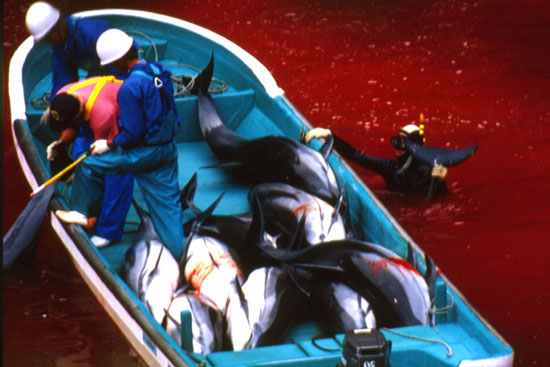
Besides its effectively genius simple mediation techniques (TVs strapped to protesting bodies in public spaces jihad-style; happy dolphin balloons armed with covert spycams), the fundamental argument is… unarguable. Dolphin slaughter should become an embarrassing harpoon in Japan’s public image.
– as top-of-the-food-chain eaters (like us), dolphin meat contains toxic levels of mercury (as much as 2000ppm, when safe consumption levels are .4 ppm);
– the yearly slaughter in Japan is an apparent add-on to the lucrative business of supplying tourist complexes with dolphins for swim n pet pools. Dolphins should not be kept in most or all captive situations, it causes high and depression to animals who need complex social and geographical ranges.
– most allegiances to Japan’s position on dolphin and whale killing are bought.
You can take action by texting the word DOLPHIN to sms # 44144.
The movie’s populist/activist site is here.
I followed the rather complex discussion on H-Net’s H-Animal after the SeaWorld killing of trainer Dawn Brancheau by the orca named Tilikum. What I’m going to note is a stretch, I admit, but not unlike eating meat (which I do), in which the animal in its natural state has long disappeared and what you are left with is something delectable, if not cleanly packaged, animals in zoos and aquaria are easy to perceive as a packaged commodity, far removed (even with info graphics as to their origin and natural ways of life). Neither eating meat nor consuming animals as entertainment – even when framed as sustaining or nourishing or educational – is defensible.
As usual, a better summary lies elsewhere.
Excerpt from Andrew Revkin’s dot.earth, one of the NY Times’ blogs:
I asked Carl Safina, the marine biologist, ocean campaigner and author, whether he thought utilitarian or ethical arguments dominated the film. Here’s what he said:
The film is an astonishing achievement. On your question about our relationship with fellow species, this question can be debated along several lines: sustainability, human health, humaneness, and our relationship with other species.
Killing the dolphins in those numbers is clearly sustainable.
Their meat is high in mercury but eating a little won’t hurt you, although eating it routinely could cause problems.
The dolphins are capable of panic and pain, both of which they suffer in this hunt. For millenniums, seafarers and shore-dwelling people have almost universally found dolphins to be beautiful and inspiring, and for that reason as well as their high intelligence, the human relationship with them has been special.
However, I’m uncomfortable forcing my values on other people. I like to catch and eat fish; some people understandably find that immoral. Eating dolphins is also unnecessary, but we all like to do a lot of unnecessary things, from playing baseball to going for a drive on a Sunday to eating hamburgers. And certainly Americans kill and eat tremendous numbers of cattle, which, like dolphins, are warm-blooded mammals that suckle their young.
But perhaps the most universal hallmark of human progress is the desire to minimize infliction of suffering. We have strict codes for how animals slaughtered for food must be killed, and much of it has to do with lessening their suffering.
The main problem with killing marine mammals — a much bigger problem than whether a small amount of killing is sustainable — is that it is cruel. Every real advance in human thought has had to do with expanding our circle of compassion. Cruelty to animals seems to parallel cruelty to people. So, I think the international condemnation of the dolphin killing is fair enough. There is no denying the fact that it is brutal business.
Personally, I detest the dolphin killing. One cultural aspect is worth noting: it is curious that the Japanese hunt seems to arouse more ire than the Faeroese pilot whale hunt, which is equally gruesome. Perhaps this is mere cultural bigotry. Perhaps it is because Japan’s behavior regarding dolphins, whales and fishing is so outside global norms. And because their policies in international bodies such as fisheries commissions, the whaling commission, and the Convention on International Trade in Endangered Species are disruptive enough to have global consequences.
Another fascinating aspect of the film that I discussed was simply that Mr. Psihoyos had perfected a new way of telling true stories that is something other than journalism — and fills a gap as the resources and reach of traditional media shrink.
With small high-definition cameras and the power of the Web, anyone — from a community activist to a journalism student — can now document and disseminate imagery on issues that matter. Also, activists have recruited enough supporters (Bob Barker buying a ship for the Sea Shepherd Conservation Society, for instance) that they can patrol the vast southern ocean tracking Japan’s whaling fleet when the media, and even other governments, are unable to do so. In the end, as I’ve been saying lately, it appears that traditional media are a shrinking wedge of the expanding pie of global electronic storytelling. “The Cove” is an example of someone creatively filling the void.
image from Encyclopedia Brittanica's Advocacy for Animals